I wake early just before dawn, and the first thing I do is to open the curtains. To be with the river again. It is deserted outside and still dark. The bridges with their arches and supports in solid lines against the sky, illuminated, guarding the night. It is cold so I open the curtains wide and climb back under the covers. I want to sit and watch the sun rise and describe the scene outside, to try and get closer to the bridges in words, in pencil lines. I am trying to tether myself to the concrete reality of these bridges, hoping to map their crossings.
Memory
Featured
Perimeter Lines
The loss of light seems to speed up at this time, or to happen imperceptibly, so that suddenly the evening feels shrouded in it: the mystery at the heart of every cycle of time. The folding of darkness, covering and concealing, like the tracks I follow, onwards into lost time, caught in their own circle ... And now I sense how the city crosses into the tracks, and the tracks blend into the city.
Featured

The Signalman’s House
It was possible to walk to the end of the viaduct, in dense woodland, at the bottom end of the park near where she grew up. Along the road that skirted the edges of the park, she would crane to see passing glimpses from the window as the car passed by. Just before the steep descent into the valley, when her mind was on other things. Her memory began to fail her as to its exact location. More and more it seemed less likely to be how she remembered.
Featured

Tunnels
It can seem bewildering, the sudden onset of night. Alone amongst strangers. In the city with the windows open and the dark falling over us, we can see our lives reflected across to other windows, as images. Lit up in windows we turn off the lights, to be visible shadows only.
Featured
Nina’s Waltz
It is many years later that she writes it down. The simplicity of the notes, tapped out on the piano, bring back the music of Nina’s waltz until she is standing there, fragile yet strong and graceful. Lit up against the dark exterior of the tent, with the mechanism of the trapeze behind.
New writing published by Echtrai Journal
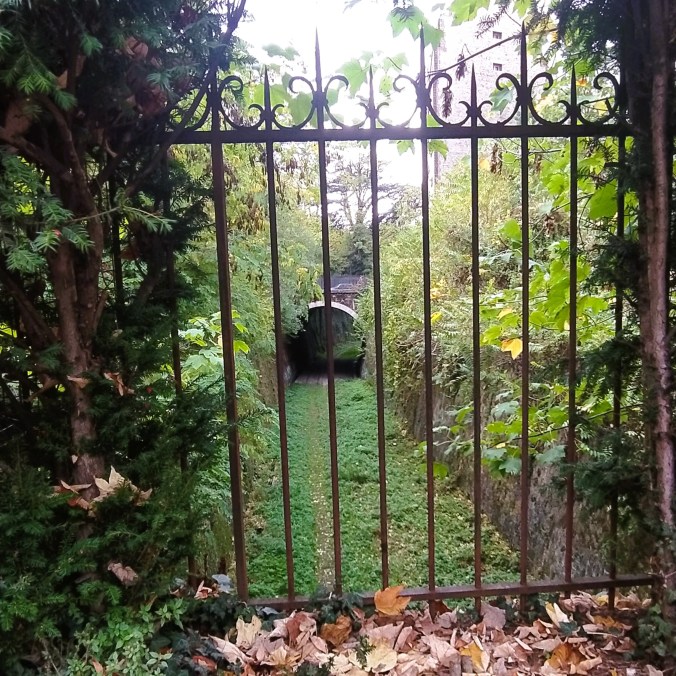
I begin following railway lines because I have been thinking about the disused railway track that ran through the deepest edges of the park in the town where I grew up. Steep banks obscured by trees. The entrance to the park, and the dark green railings running alongside the road, that create a feeling of motion, of dreaming.
Featured

Passages: on the Rue des Thermopyles
Looking back along the cobbled lane there is a sense of green everywhere, hushed voices from the shared garden. The shade of trees and dappled sunlight, rooftops, and blue sky. Each glimpse is like framing a different fall of shadow and sunlight and sometimes the street seems to lengthen depending on the angle I look, as figures emerge and fade into the space of the passage and around corners. I want to notice every detail, to know the story behind every door.
Featured

Out of Place No.03: ‘Missing Person’ by Patrick Modiano
What is striking on reading Missing Person is the detailed geography of the city, and the number of references to street names and specific places. The city becomes a site of clues or signs to be followed like a trail. They provide something tangible. Signs that might point the way through the darkness of memory. ‘I use them to try to obtain reference points. Buildings bring back memories and the more precise the setting the better it suits my imagination.’ I couldn’t resist the urge to map this book, the specific locations contrast with the uncertainty and lack of solidity which are the overall effect of the book.
Featured

Out of Place No.01: ‘Housekeeping’ by Marilynne Robinson
Ruthie begins to find a greater awareness of fragility, of instability and impermanence. To stay still in the book, is to be caught up in the ordered time of the domestic. It can be a way to hold the past at a distance and keep out the ghosts of those who are absent or lost. For Ruthie and Sylvie, these fragments of memory threaten to overwhelm the present, and a life of drifting become a way of comprehending the ghosts of the past, of keeping them alive through movement.
Featured

Gloomy Sunday/Sombre Dimanche
There is something powerful and haunting about listening to this song, and it has a dark and mournful melody, particularly in the earliest versions. Lyrically poetic, it also contains a sense of its time, of the dread and uncertainty that shadowed the 1930s. The legends that have attached to the song, may also be present in each listen, and it is interesting to think about how popular songs might travel and adapt over time. Even without its notoriety, there is an atmosphere of sadness evoked by the song, and something compelling, something that is hard to shake.
 The Street Walks In