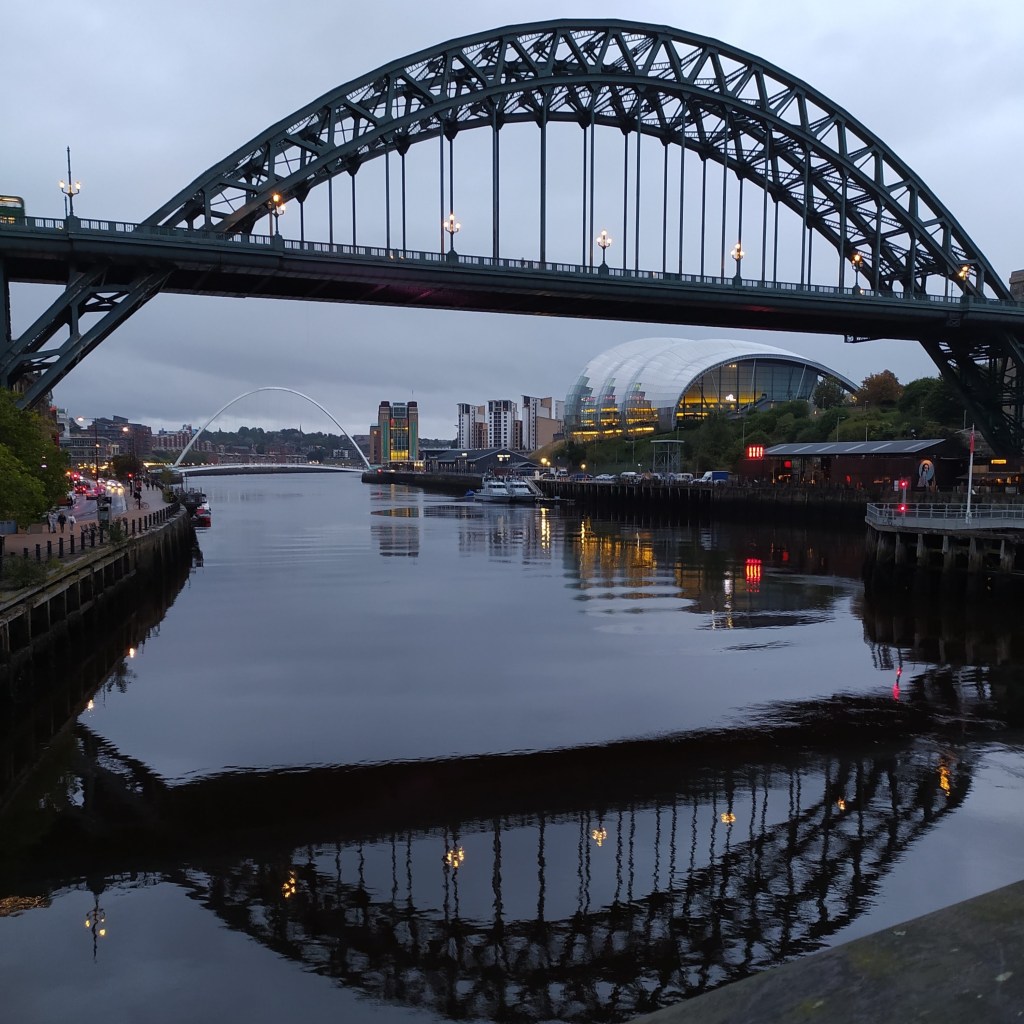
For my visit to the city, I have chosen a room that overlooks the river. In the lengthening shadows across the dark water stands the Tyne Bridge, the most iconic of the bridges, tall and stately, arching over into the sky. As I walk slowly back along the quayside and watch the daylight fade, lamps are beginning to be lit along the pavements and by the water. The change of the light is a good time to observe. In a cocktail bar on the corner, under the shadow of the bridge. In the slow passage of time, of evening turning into night, long after the light has faded.
The Tyne Bridge casts a long and deep reflection in the water. The quayside is lit and full of life. I am grateful for the dusk, that portal of time that offers a glimpse into the meaning of places. Threading my memories of the city together like beads of light. In my photograph, the sweep of the bridges and a bus crossing over, an illuminated blur in motion.
Back in my hotel room I watch through tall windows, the dusk become evening and the changing lights glancing and shimmering. Down below, the paving stones shine brightly, wet from the rain that fell. The streetlights make elongated reflections on the pavement, bowing slightly, laid out at intervals. A couple joined together leave their shadows as they walk. A vivid scattered radiance across the dark shining pavements.
In the other direction, lucent train carriages move across the top of the railway bridge, arriving or departing from Newcastle central station. On the opposite bank of the river, a long glow reflected in the water from the buildings and the jetties, diffused in blue, green, red. The trees are part obscured; part lit up. As night falls, the railway bridge becomes brighter and the river darker than the sky, its smooth surface broken only by prismatic patterns.
As I watch, reflections from inside the room start to mingle with pieces of the picture outside. The river calls my eyes to the distance of the other shore, the long stretch of water beckoning onward. The outlines of the bridges play with shadows in the water. I wait to see the Metro trains crossing over, the water becoming mysterious and opaque. The lights blur and move with my own motion. A blending together of inside and outside, ghostly city scape.
The Metro bridge is starting to fade, to disappear, leaving a spectral, ethereal glow on the sky above. The curtain in my window, transparent in its folds. The outline of the bridges has a clarity that the overcast sky cannot give.
I wake early just before dawn, and the first thing I do is to open the curtains. To be with the river again. It is deserted outside and still dark. The bridges with their arches and supports in solid lines against the sky, illuminated, guarding the night.
It is cold so I open the curtains wide and climb back under the covers. I want to sit and watch the sun rise and describe the scene outside, to try and get closer to the bridges in words, in pencil lines. I am trying to tether myself to the concrete reality of these bridges, hoping to map their crossings. A willed suspension of time and gravity; across the gulf between here and there, between then and now.
The dawn looks blue. Night blue sky and twilight blue river. The lines of the Metro bridge have changed once more, to a gentle tone, like the sky that surrounds them. The bridge’s shadow looks unstable, like a rope ladder crossing the water.
The lights down below are crested, beaming, blurred. In the distance the sky is changing to a yellow-orange sunrise. The river colder without its coloured lights, turning grey in currents and ripples, holding off the daylight. The bridges which seemed so dense and solid in colour, and so unyielding, now seem to have dimensions that reflect the light, and reveal their structures. The morning light creates a contrast, revealing the intricate metalwork of the railway bridge, in lines that cross and angle, against the shadowy stone. In the river blue, the bridge is still, dark, mysterious; its reflection doesn’t allow for this complex change of the light.
In a short space of time, the scene outside the window is transformed. The clear blue of dawn becomes a cloudy day with brightness at its edges, fading a little, losing its colour. It is changing all the time and now the morning beckons to me. The sound of a train crossing the Metro bridge.

I open the map, and trace the Newcastle streets, trying to remember. There are those moments you can watch back in your mind, like episodes or glimpses, of a film reel that is interrupted, that cannot be restored to show a continuous narrative. It is just a play of stills, but you can move from one to the next, changing their order.
Was it towards the end of my time here that I began to walk alone in the city, to take my time, and pause in the moments before work and home? It was the year I stayed on after finishing my studies. The first threads of anxiety about what I should do next. Where would it come from this life, and how to live it?
I went for a walk to see the arrival of the Millennium Bridge. It was pulled by boat to its resting place, between the quayside and Gateshead, the newly built art gallery and concert hall. It felt like taking leave, the arrival of the bridge was the end of my time in the city. The place I had called home for a few years, the place I had chosen. I didn’t know how to stay, what came next. Now I think of other options, all the parallel bridges or routes I might have chosen. If it is even a choosing. A series of moments with the view up ahead, and the bridges behind.
As I set out, the sky is a clearer blue and I am glad for the clarity of the light. I love the feeling of being out in the morning with hours of exploring ahead. The bridges present themselves in a dynamic view for walking. Their reflections plunge deeply into the rippled lightness of river currents. There are patterns to be seen everywhere, from every angle. A sign reads, The Tyne Bridges: Landmarks which have become the symbols of Tyneside. A bridge has spanned the River Tyne at this point since the Romans.
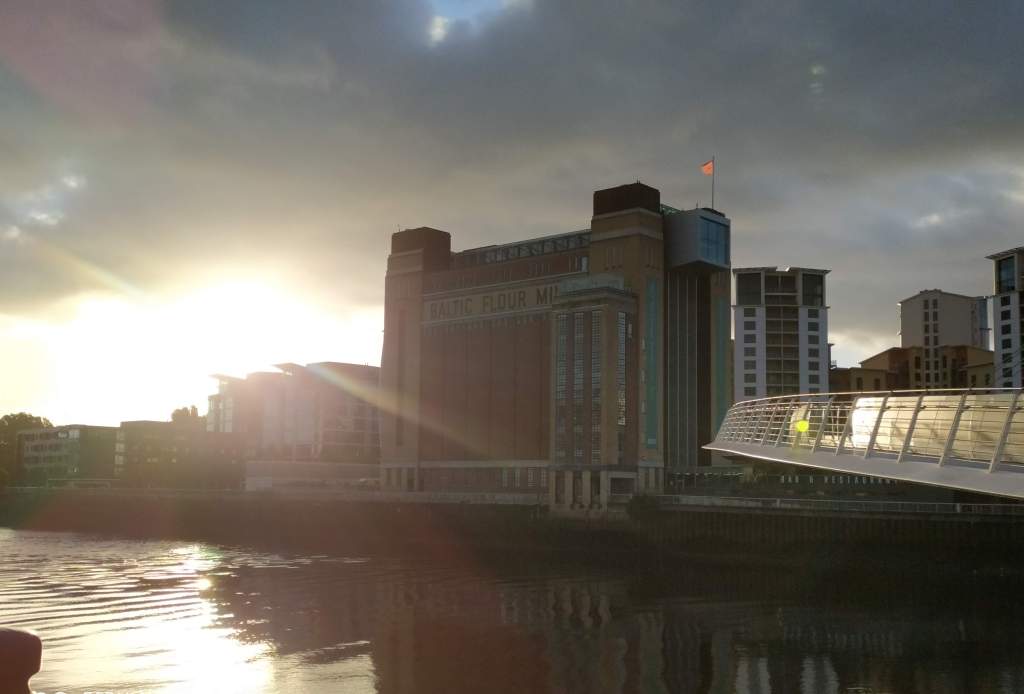
The water looks heavy. Shapes gather and move in a slow churn. Heavy dark clouds with just one pocket of blue sky. The Baltic Flour Mill building displays its long shadow as an echo in the water, remembering deep down and dark. The paving stones along the quayside, almost warm and reassuring, in the sunlight and shadows. I head onwards towards the brightness of the skies ahead …to walk, to walk… The sun and cloud keep shifting, moving, breaking. Each step opens out a new perspective. A changing view, my motion, my walking.
I have reached the wharf where I will turn away from the river in the direction of the Ouseburn Valley. There are fishing boats gathered as if sheltering, or washed up, marooned on muddy banks. The red brick arches of the Glasshouse Bridge, wide and open. A plaque dates the present bridge to 1878: A bridge has spanned the Ouseburn at this point since the 1640s when glassworks became established along the St Lawrence shore. The river continuing its course onwards to the sea. I pause to watch the swooping seabirds gliding and falling, circling the sweep of riverbank.
It was moving to this other part of the city that the quayside opened out to me. We took a flat with friends in the area between Heaton and Byker. We shared a room overlooking the street that looked towards Shields Road on one side, and to the other, the gates of the park. One sunny day in the back lane behind the houses we had a spontaneous water fight, and later a barbecue when we daubed ourselves in charcoal. I took a job. It was a steady stream of income, and the rest of the time was my own. Catching the number 1 bus, from the station to our flat and sitting at the front, watching the passing moments of the journey, the slowly darkening sky.
Was it in that year that I began to feel a sense of belonging here, to feel a connection to this city, that I can still detect, as if I had frozen the feeling and captured it?
Walking the hill from Byker and crossing into the Ouseburn Valley. In the shadow of the bridge, under the archway is the Tyne pub. The garden where we sat under the arches and painted brickwork, with lights strung above and the dark blue sky forming at the edges of our view. Inside, the posters on the walls and the feeling of belonging, that creeps in for just a few moments, but never too long. Nearby is the Free Trade, with its garden at a vantage point looking down along the river. A place of intense conversations and lost hours, the best way to spend a liberated afternoon.
I follow the road towards warehouses and steel yards. The Ouseburn valley lies at the industrial edges of the city. The backdrop of dark clouds and deep yellow light showing rooftops and colours. The clouds hang above the steel works, the light and the dark crossing and shaping each other.
I look across the valley at roofs strewn with ivy, at empty and abandoned spaces, unused and forgotten, the inside of the buildings remote and unimaginable. Ruined walls, shuttered doors and windows, dark yards fenced in. Intriguing structures that keep their wreckage intact, half ruined and entangled, windows that reflect the sky. Shy bairns get nowt, I read, written on the wall. Industrial edgelands that retain this sense of ruin, of improvised presents, the material and transitory.
I wander on into the heart of the Ouseburn, following the trail that leads around the valley. In the water that is more like a stream, a trickle from the river, lie reflected the edifice of mill buildings with wide windows, where plants sprout and grow from the sandstone.
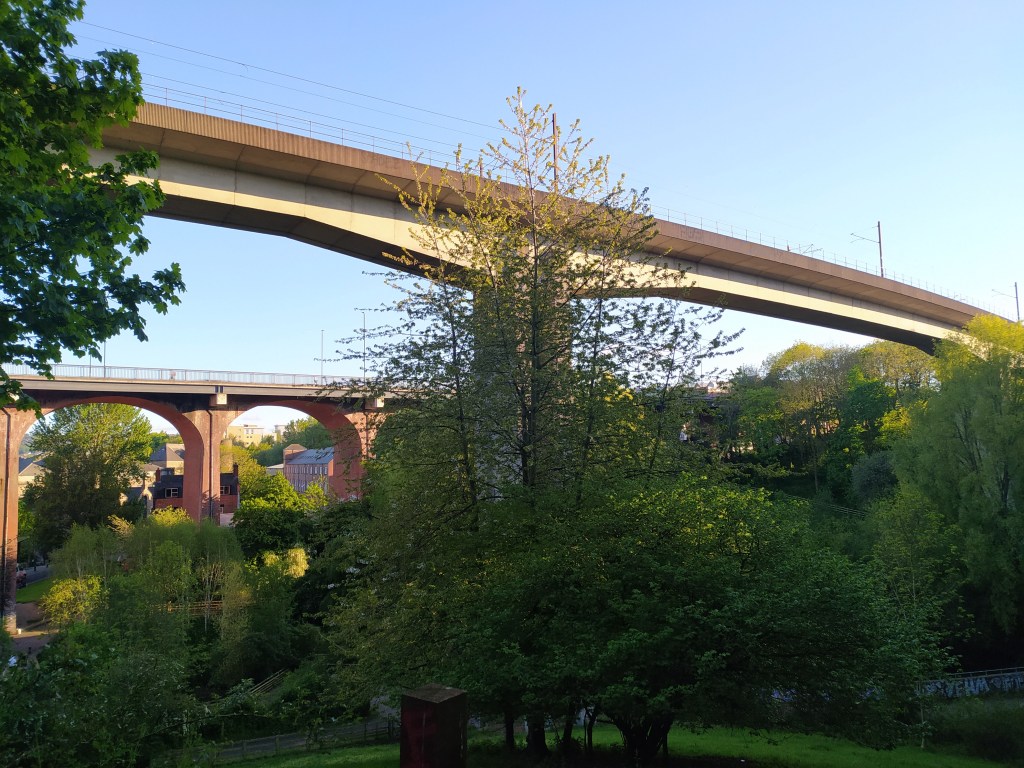
I find a sign, fading covered in elements, pinned to the railings: Northumberland Lead Works. The railings are grown over by leaves and branches, a tangle of interwoven strands, twisted layers of stems, leaves and branches. The mix of heritage, with iron railings slowly decaying, left to be covered and grown over. The sign itself weathered and greened by the elements. The Ouseburn Viaduct, its pillars and ironwork lattice half hidden by trees and adjacent structures.
Three bridges span the Ouseburn Valley, to carry the railway, road, and Metro across it. I see a freight train passing, the bridges line up in arches, the valley laid out below. Layers of history formed within a landscape. Someone has painted a great owl swooping just below the shadow of the bridge, its great wings spread, flying outwards from the clouds, the kingfisher rising from the water.
Byker Bridge stretches tall across the valley towards the city’s busy roads. Constructed from red brick its semi elliptical arches concealed and only visible from below. Walking this bridge could feel high, spare, and desolate. The loneliness of cities. The places we can only go alone.
There is one memory that solidifies, a moment’s awareness. We had just moved into the new house. Walking home across the bridge that night we stopped to look at the sky, the stars, the city lights behind us. As we walked across, the world seemed wide and open, the descent to the valley covered over in darkness.
The pavement we walked along. You took my hand and we walked across the bridge. My memory fails me. Was there starlight, or shifting clouds, the night we crossed the bridge and looked out across the valley? What made us feel a sense of the momentous, of the world laid out below us?
I walk back to the shadows in the water, the bridges curving across in echoes. Shadows and reflections. A beam of light breaking into scattered crystals, dotted white into black water, an illusory stasis among its constant currents. In the paving stones are puddles of blue and white cloud. The pools of water create their own worlds of silver and shadow, still and hovering, not like the layered currents of river. The river is swathes of stillness and beckoning sweeps of grey-black water that seem constant and changing.
At the edge of the water stand sheets of coloured glass, placed so they can be walked around, looked through and across, in panes that mirror and reflect the light from all angles. Looking around me, I can see where the idea came from. Rays of sun strike the edges of the walkway on the Millennium Bridge, creating beams of light in a prism of rainbow colours.
The clouds shift and bend, darker lighter brighter. The light makes echoes of the buildings in the water. Distorted motion next to the spun bright white sheen of the river, glinting bright silver, twisting rainbow beams.
When I look back now, the scene behind me is lit once more. The sun points its diagonal rays to light up objects selectively. It strikes the windows on the side of the Baltic Flour Mill on its way but obscures the bridges. The paving stones along the quayside are bathed in light, and the buildings golden yellow. Behind loom the dark grey clouds, dense and ominous, contrasting with the buildings the sun picks out.
The scale of everything seems to have shifted. The shadows fall behind and lengthen dramatically, the river stretches out in a trail of laden silver. There is a blue horizon, suspended in cloud, momentously grey and changing. Clouds break free while others pull together in endless possibilities. Where the clouds gather at their darkest edges, is where they meet and hover across the brightest, most vivid part of the sky. Across the riverbank, the buildings and the trees have become silhouettes, the skyline obscured into shapes with no details.
I spend the afternoon walking streets that are familiar but strange all at once, besieged by memories. A cloak drawn across those days, obscuring them from view, revealed for a moment in the wide smile of a photograph. That time of less responsibility, where things started to creep in slowly, a sense of unravelling.
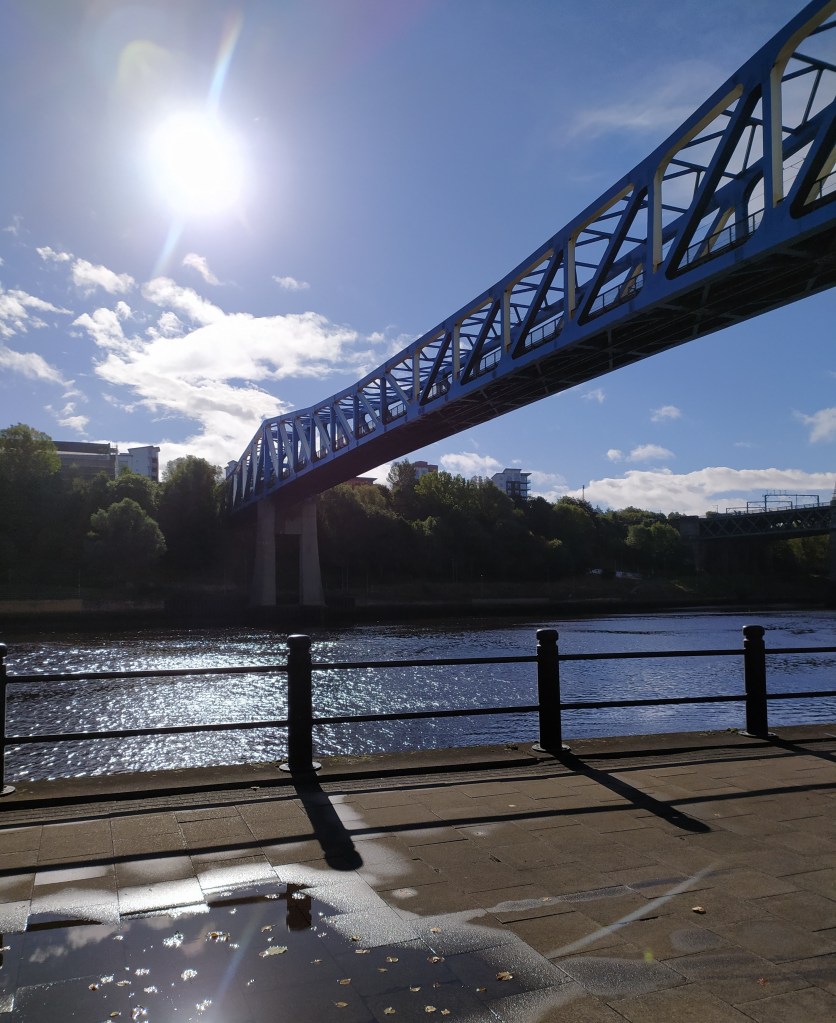
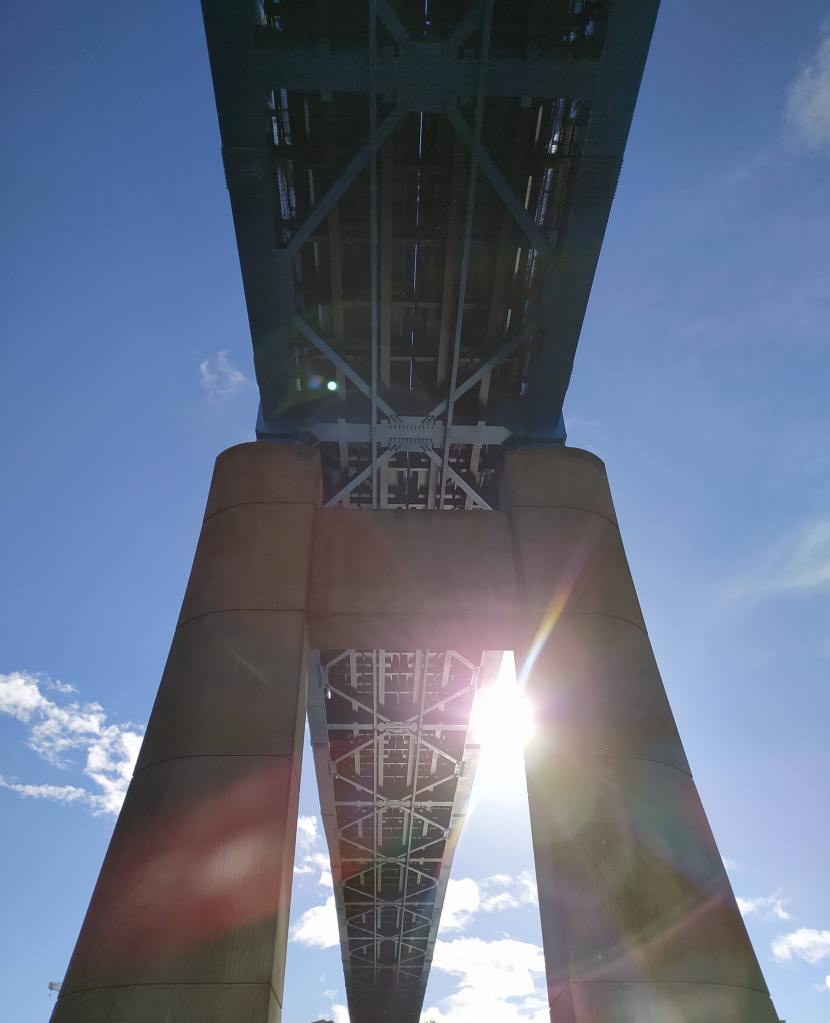
I am standing by the Metro Bridge contemplating the light that ripples through the water and the puddles on the paving stones. I like being here, waiting for the metro trains to pass over. The Metro Bridge is painted blue, and its simple clear lines stand out against the sky. The tracks and connections above. The concrete supports patterned with light that casts down and through the bridge. I look up to the blue of the sky, the sun and scattered clouds, the trees, the blue of the bridge. From this angle, it is as though they clarify each other. I stand and wait for a train to pass across, looking directly upwards, the lines of steel crossing over. The perspective of the bridge, its solid supports, the metro lines striking outwards across the river.
On the High Level Bridge, a train crosses over and I recall the view from the train as a memory I carried with me. Returning to Newcastle, something of that anticipation remains, each arrival an enactment. I would carefully watch the approach to the city, waiting to glimpse the view down the river and its cascade of bridges.
The High Level Bridge, the world’s first combined road and railway bridge and the oldest of the existing bridges that span the River Tyne. You can cross its high walkway, a network of iron structure, and look across the river towards the city below, a roadway running alongside. Looking back, I sense that my relationship with the north is complex, simultaneously a place of darkness and light, of ambivalence. Watching the bridges, suspended across the river, always the sense of arrival, of just passing through.
I am drawn to this part of the city, to the bridges, because they make me think of all the ghosts of the past, crossing back into shadows. As I return to my hotel, I feel the urge to explain what I am doing here, to make up a story. In a club across the city, I can still hear a haunting karaoke performance, of Riders on the Storm, an awareness of the street just outside, the quiet of the bar at the end of the night. The fall of darkness leaves a shadow behind me.
In my view the bridges are mingled together. Distance changes the perspective and narrows the gaps between them, to make them seem like one intricately complex bridge of many parts. The lights are beginning to reflect into the river below. The bridges echo, complement, displace each other. The rainbow light keeps coming, falling onto bridges and other concealed places. Who can remember, who can really know?
I look back towards the Tyne Bridge. As the light fades, the sky is starting to clear and the bridge lies reflected below in the water, flickering, and blurring its image, becoming a darkening blue. I am struck by how the bridges blend together in lines, in shapes and angles. The structure of each bridge, in distance, in sloping lines patterned with curves and supports that cross each other.
It strikes me that the bridges protect and frame the city. With their iron and stone, arches and supports, lights and solid places. They provide shelter and homes for the birds. Watching over the city at night, enfolding, holding it together from above. The bridges are a memory of what went before, where it is possible to map the landscape in layers of time, the path of rivers and their crossings. They connect the past and the present, bring stories of the city into view. The bridges that remain; the bridges that are no longer there.
The bridges come together in lines to tell a story. Blessed are those who follow a straight path. My trail is fleeting, like the windows of a passing train. Made up of certain clear moments and much that is obscured, that passes in a blur. Scattered, like the falling patterns of light that cross the water.
 The Street Walks In
A wonderful tribute and meditation on the river and its bridges Anna. I’m from North Shields, at the river mouth, so this is my city too.
LikeLike
Thanks so much for reading this. A lot about bridges, but I hope my love for the city came through!
LikeLike